What to Tell the Person Covering Your Inbox About How You Write


When somebody answers email in your place, they are usually handed the facts: which customers, which deadlines, where the files are. How you write is left for them to guess. This is the part of a handover note that covers it. Copy it and put your own answers in the brackets.
How I write, for whoever answers in my place
I usually open with [the reader’s first name and a comma / Hi and the name / nothing].
I usually end with [my first name / Thanks and my name / Regards / nothing].
I [use / do not use] contractions such as I’m, don’t and we’ll.
I [never use / sometimes use] an exclamation mark.Attached are the last fifteen emails I sent. Where they disagree with this note, follow them.
Fill it in from your Sent folder
You do not have to know how you write. Open your Sent folder, take the last fifteen emails that have more than a line of text in them, and count four things. It takes about five minutes.
- How many open with the reader’s name, how many with “Hi” or “Dear”, and how many with nothing. Write down the commonest. If a second is close behind, write that down too.
- How many end with your name alone, how many with “Thanks”, how many with “Regards” or “Best”, and how many with nothing after the last sentence.
- Whether you write “I’m” and “don’t” or “I am” and “do not”. Look at ten places where either would fit and you will know.
- How many have an exclamation mark anywhere in them.
Take the last fifteen as they come. If you choose your best ones, the note describes someone tidier than you.
Two real writers, two different notes
These are two people from the same company, measured over every email of theirs in the test described below.
The first opens 83% of emails with the reader’s first name and ends 84% with their own first name and nothing else. They contract in 21% of the places where they could. In more than 2,700 emails there are three with an exclamation mark.
The second opens 61% of emails with nothing at all and 31% with “Hi”. Three in four end with no sign-off. They contract in 62% of the places where they could, and more than half of their emails, some 350 in all, have an exclamation mark.
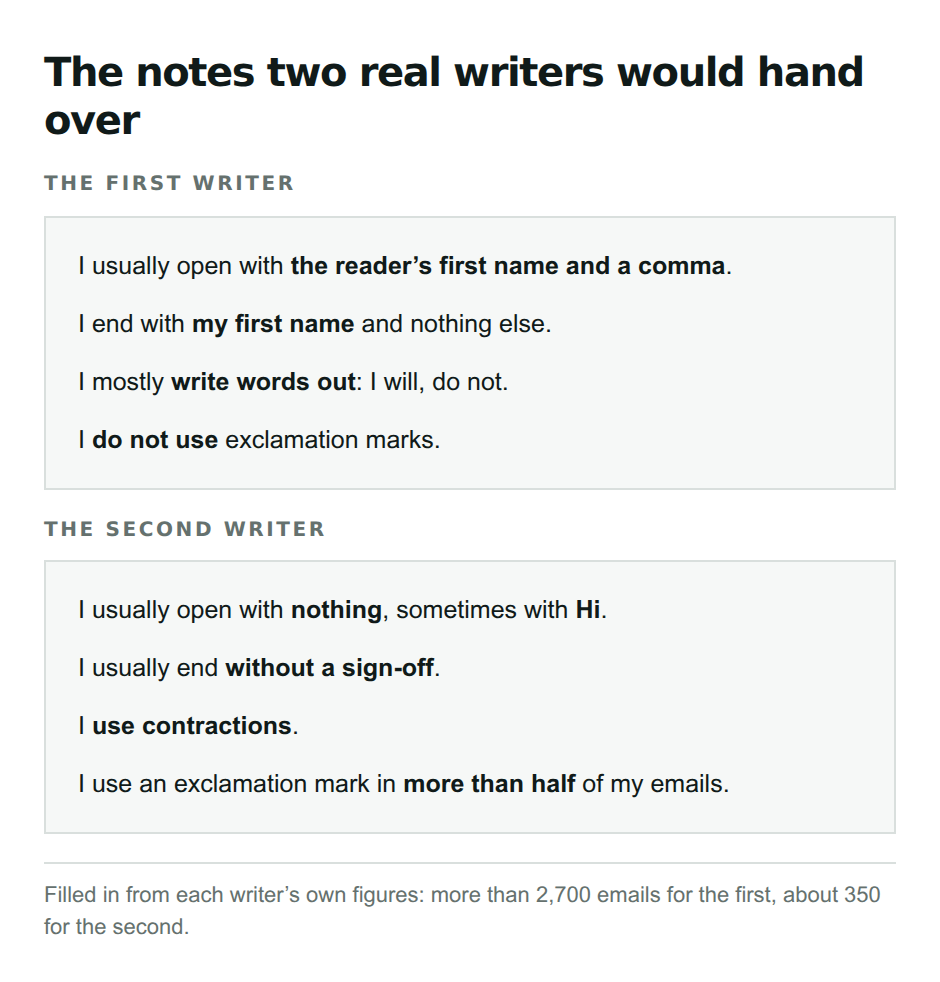
Give the first writer’s inbox to someone who writes like the second and every fact in the replies can be right while every reader notices that something has changed.
Why these four lines and not others
We took the sent emails of 97 people at one company, 69,737 emails from the public Enron collection, and for each person drew two separate sets of 15. Then we measured the same habits in both sets and asked how well the figure from one set predicts the figure from the other, across the 97 people. A score near 1 means the habit is fixed in the person: any 15 of their emails will show it. A score near 0 means two sets by one person are no more alike than sets by two strangers.
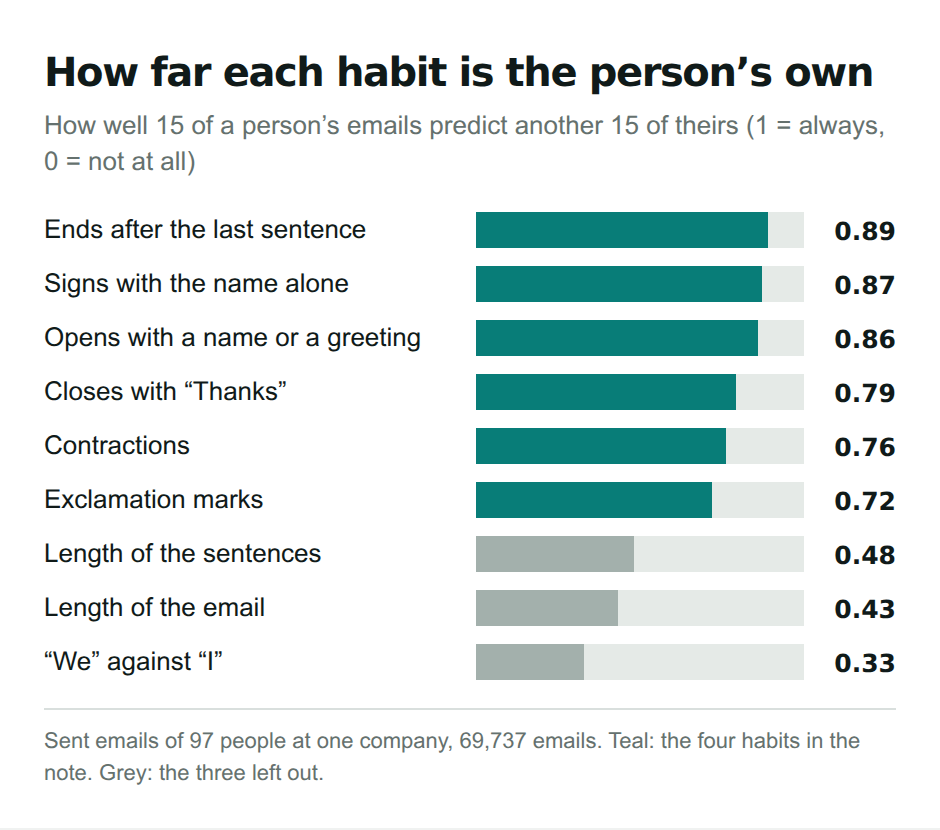
How an email ends scored highest. Whether a person stops after the last sentence scored 0.89, whether they sign with their name alone 0.87, and whether they close with “Thanks” 0.79. How it opens scored 0.86, contractions 0.76 and exclamation marks 0.72.
The other three things I measured did not hold. How long a person’s emails are scored 0.43, how long their sentences are scored 0.48, and their share of “we” against “I” scored 0.33. In those, a person’s own emails differ from each other nearly as much as they differ from anybody else’s. I take that to mean they follow the message and not the writer: a reply to a question is short whoever writes it, and “we” turns up when a team has done something. So I would not tell a stand-in to keep it short or to say “we”. They will get both right by answering what was asked.
One limit belongs here. In these mailboxes, from the years around 2000, an opening is nearly always the reader’s first name and a comma. “Hi” and “Dear” are rare, so the test says the opening is a steady habit and says little about the choice between those two.
Why fifteen emails, and why the note says “usually”
We ran the same test with sets of five, and every score fell: exclamation marks from 0.72 to 0.44, a closing “Thanks” from 0.79 to 0.56, the opening from 0.86 to 0.68, contractions from 0.76 to 0.63. Five emails are too few to show a habit. One of the five happens to have an exclamation mark, and your stand-in concludes you are fond of them.
The word “usually” is in the note because of a mistake of mine. The first time I tried to pin down a person’s writing from fifteen of their emails, I treated every difference as a signal. If someone’s emails mostly opened with a name, an email without one was marked as unlike them. I ran that on 89 of these mailboxes, and it marked 31% of each person’s own other emails. People do not open every email the same way. They drop the greeting in a quick reply and put it back for a stranger.
When I changed it to mark only an opening or an ending of a different kind, a “Dear” from someone who writes “Hi”, and made the other parts as cautious, the marks on a person’s own emails fell to 7%, against 16% on other people’s. With five sample emails in place of fifteen they were back up to 15%.
So each line of the note describes a habit and not a rule. Tell a stand-in that you always open with the reader’s name and they will put it on a three-word reply where you never would. Tell them what you usually do, give them the fifteen emails, and let them see the exceptions for themselves. It is also why I would promise no more than this. Four habits and fifteen examples make an email look like yours. They do not make it sound like you, and nothing this short could.
Whose name goes at the bottom
One thing matters more than any of the four lines, and it is a view of mine, not a result of the test. If the reply goes out under your name, it should read like yours, and the note is for that. If it goes out under the stand-in’s own name, with a line saying they are covering for you, they should write as themselves and the note is not needed at all. What I would not do is the mixture: your name at the bottom of an email that plainly is not yours. Your out-of-office message should say who is answering and until when.