How Often Emails Misspell the Reader’s Name and How to Get It Right

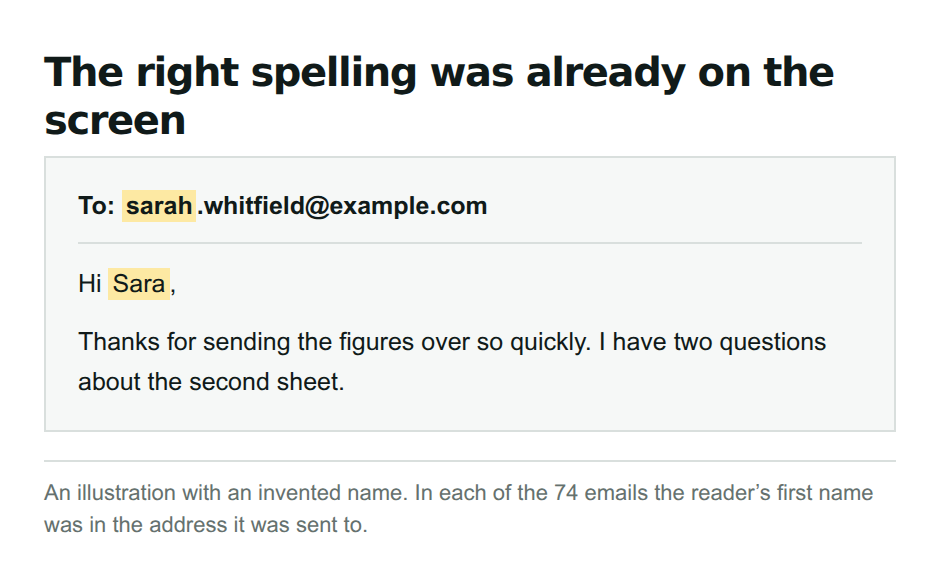
Take the spelling from the address line, not from memory. It is the one place on your screen where the name is certain to be right, and it sits a few lines above the greeting. In the real emails counted below, every writer who got a reader’s name wrong had the right spelling there in front of them.
How often does an email get the reader’s name wrong?
About once in a hundred: 74 times in 7,525 emails. The count is of sent emails from one company: the Enron email dataset that Carnegie Mellon University distributes, most of it written in 2000 and 2001. We kept the emails addressed to exactly one person with nobody copied, where the address has the form first name, dot, last name and the sender’s own text opens with that person’s first name, spelled as the address has it or within a letter or two of it. That left 7,525. In 7,451 of them the greeting has the name as the address has it, and in 74 it has another spelling.
A shorter form is not a mistake and is not counted as one. Another 625 emails to one person open with a short form or a pet name, the way a Michael gets written to as Mike. Whether that is welcome is a different question, and an address cannot answer it. Nor can the count say anything about a person who spells their own name differently from their employer’s directory, or about any company but this one.
Which names go wrong?
Ordinary ones. In 61 of the 74 emails the reader’s name is in a standard English spelling dictionary. What these names tend to have is a twin.
In 41 of the 74, the greeting uses another accepted spelling of the same name: one l where the reader has two, a -y where the reader ends in -ey or -i, an e where the reader has an i. In 25 it is a spelling nobody uses, because two letters changed places or one was dropped, doubled or mistyped. The last 8 came out as something else: seven times as a different name one or two letters away, and once as an ordinary English word.
Twins are everywhere. In the US Census Bureau’s list of first names from the 1990 census, 144 pairs among the 400 most common women’s names and the 400 most common men’s names begin with the same letter and differ by one letter, and 18% of women and 23% of men have a name that is half of such a pair. These are some of them. The pairs are taken from that census list, not from the emails, and nothing here identifies a person in them.
- One letter or two: Alan and Allan, Philip and Phillip, Glen and Glenn, Mathew and Matthew, Michele and Michelle
- The ending: Sara and Sarah, Ann and Anne, Carol and Carole, Stacy and Stacey, Tracy and Tracey, Lindsay and Lindsey
- One letter inside: Brian and Bryan, Kristen and Kristin, Eric and Erik, Mark and Marc, Teresa and Theresa
- A different name altogether: Maria and Marie, Julia and Julie, Christina and Christine, Diana and Diane, Jean and Joan, John and Jon
Why does nobody notice before sending?
It is not that the name is unfamiliar. In 19 of the 74 emails the same sender spelled the same reader’s name correctly in another email in the set. One of them had written a colleague’s name correctly 158 times and then got it wrong twice, in two different ways. A name is the first thing typed, at the moment the writer is thinking about the second.
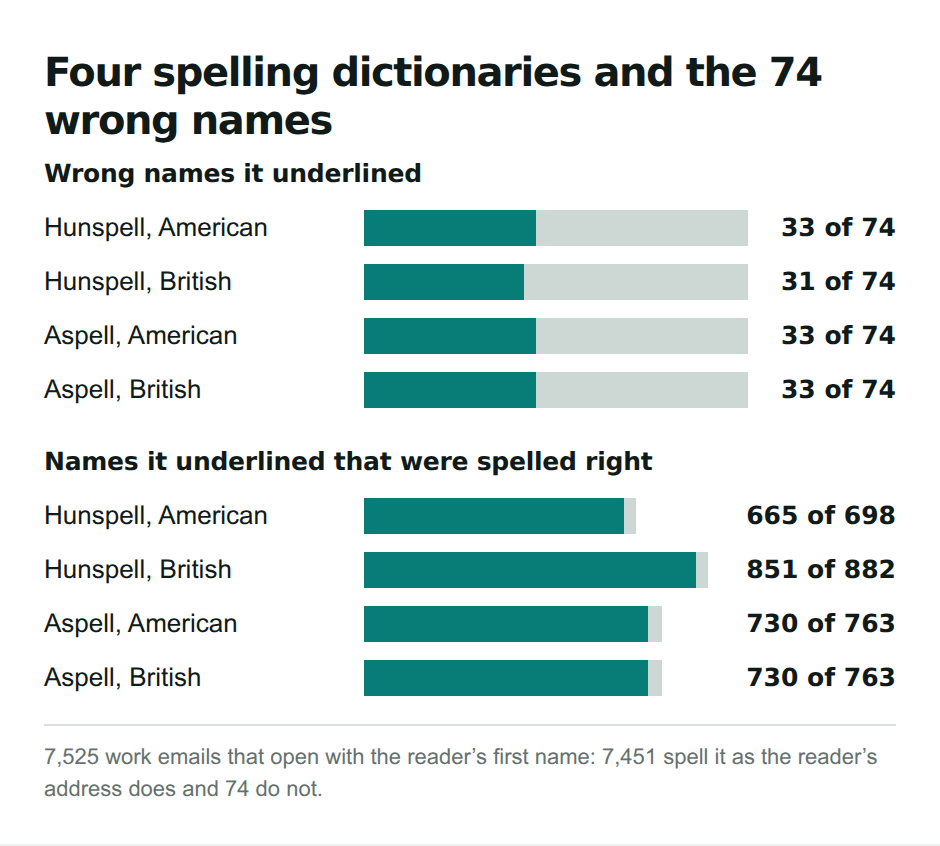
And a spellchecker does not catch it. I tried four dictionaries: the American and the British ones of Hunspell 1.7, the open-source checker in LibreOffice and Firefox, and the American and the British ones of Aspell 0.60. Each lets between 41 and 43 of the 74 wrong spellings through without a mark, because another accepted spelling of a name is a word it knows.
What they do underline is mostly right. Hunspell’s American dictionary does not know 200 of the 857 different first names that were spelled correctly, so across these emails it would have underlined 698 names, and 665 of them were correct. The other three dictionaries do the same or worse. Depending on the dictionary, an underline under a name was a real mistake once in 21 to once in 28 times.
My own first name gets the red line from all four, which is one reason I would never let an underline settle anything about a name. The checkers built into mail programs were not part of this.
How do I get the name right?
In this order, which is the order of what is already on your screen.
- Look up from the greeting to the address line and compare the two letter by letter. In all 74 emails that alone would have been enough. In this company about seven addresses in ten had the first name in them. Where an address does not, the name your mail program shows beside it usually does.
- In a reply, copy the name from the way they signed. A signature gives you the spelling and also what the person wants to be called, which is the thing the 625 short forms were guessing at.
- Read the greeting last. It was the first thing you typed. Make it the last thing you look at before sending.
- Look twice at a name with a twin, and hardest at the names you are sure of. Twins account for 41 of the 74, and people who had spelled the name correctly before account for 19.
- Add the names of the people you write to most to your dictionary. Until you do, a red line under a name tells you almost nothing. After that, a red line under one of those names is a slip.
I put the address first and the dictionary last for a reason. The first three steps need nothing remembered and nothing looked up: the right spelling is already in the window, and the only work is to look at it. The dictionary comes last because it failed in all four trials.
What if it has already gone?
I would not send a second email about it. Spell the name correctly in your next message and say sorry in four or five words there. A separate apology makes more of the slip than the reader did. Second emails are for mistakes a reader would act on, and what those are is counted in The Mistakes People Send a Second Email to Fix.