Keep Your Foreign Degree’s Name on an English CV and Explain It in English

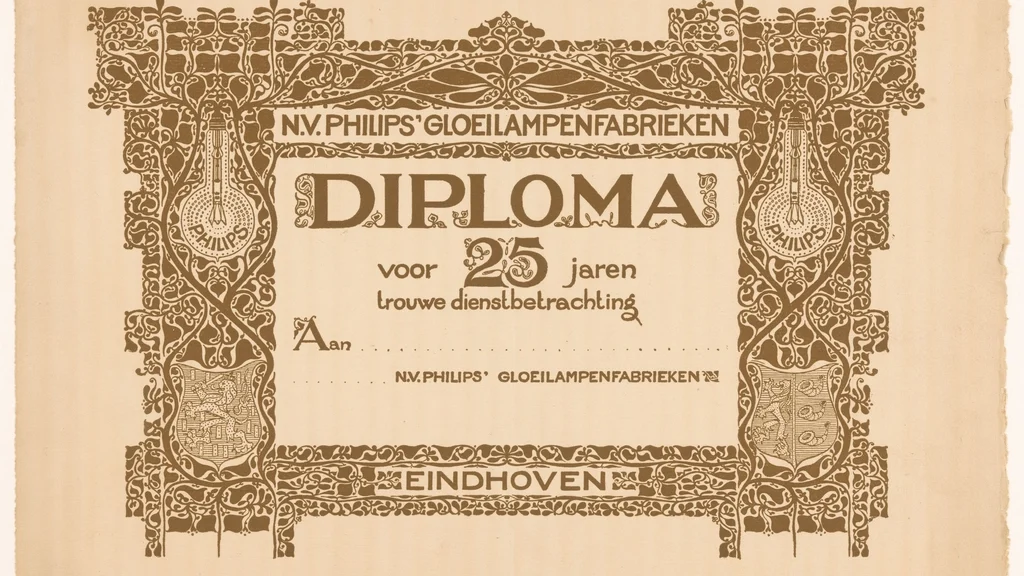
The European Union publishes examples of the Diploma Supplement, the document a university issues to explain a degree to employers in other countries. In the English example for Germany, the line for the degree is headed “Name of qualification (full, abbreviated; in original language)”, and under it stands “Diplom-Kaufmann (FH)”. A document written in English to explain a German degree leaves the degree’s name in German.
Do the same on your CV. Keep the name your certificate gives, and say in English what it is.
One line, three ways
Take that degree, a first degree in business studies from a German university of applied sciences, and put it on an English CV.
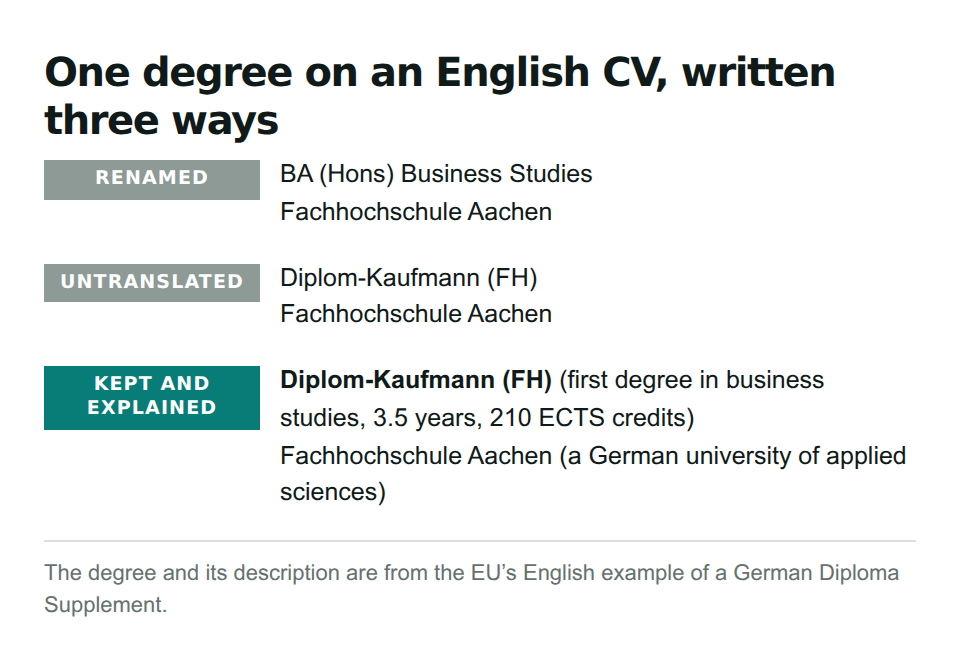
Renamed. “BA (Hons) Business Studies” is a British degree, and this is not one. It is not on the certificate, so it will not match it when an employer checks, and it says nothing true about the course, which took three and a half years. Of the three versions it is the one to avoid, because it can read as a claim to a degree you do not hold.
Untranslated. “Diplom-Kaufmann (FH)” on its own is accurate, and an employer in Britain or America will not know what it is, how long it took or whether it was a first degree or a second.
Kept and explained. The name as the certificate has it, then in English the kind of degree, the subject, the length and the credits. Every word of that explanation is in the same German example: under “Level of qualification” it says “First degree including thesis”, and under “Official length of programme” it says “3.5 years / 210 ECTS credits”.
Where to find the words for the brackets
In your own Diploma Supplement, if you have one. The EU’s page on the Diploma Supplement calls it “a document which provides information that makes it easier for employers and education institutions to understand your qualification”, and says that “Graduates in more than 40 countries have the right to receive the Diploma Supplement automatically, free of charge and in any major European language”. If you were never given one, ask the university you studied at. Its sections on the level and the length of the programme are the English you need, written by the people who awarded the degree.
If a reader wants a level, the European Qualifications Framework gives one. The EU describes it as “an 8-level, learning outcomes-based framework for all types of qualifications that serves as a translation tool between different national qualifications frameworks”, and its description of the levels says that a first-cycle degree corresponds to level 6, a second-cycle degree to level 7 and a third-cycle degree to level 8. A bachelor’s degree from a country in that system is first-cycle, so “EQF level 6” can go into the brackets.
An employer in Britain who needs more can be shown a Statement of Comparability from UK ENIC, which, in its own words, “shows how international qualifications compare to the UK education systems”. It is a paid service, and it is meant to be shown “with your original qualifications”, not in their place. Neither the statement nor the framework gives you a new name for your degree. They give the reader a way to place the one you have.
Job titles have no official English
For jobs there is no supplement to copy from. The nearest thing is ESCO, the European Commission’s classification of occupations, which gives each occupation a label in English beside its labels in other languages. I tried it on twenty job titles as people write them on German and Spanish CVs.
For four it gave the job as its first answer: Lagerist as warehouse worker, Auxiliar administrativo as administrative assistant, Cajera as cashier, Responsable de compras as purchasing manager. For seven it gave a narrower job or a neighbouring one, such as “bank teller” for Bankkaufmann. For four it gave a different job altogether: “travel agent” for Bürokaufmann, “fish preparation operator” for Dependienta, “live chat operator” for Kundenberater, “bartender” for Camarero. For the last five, among them Industriekauffrau and Becario, it found nothing. It has no Albanian labels at all.
ESCO is built to classify jobs, not to translate a CV, and the trial shows it. So for a job title, write in English what the job was, and borrow the words of the advert you are answering where they fit. Keep the original only where the title is itself a qualification, such as Industriekauffrau, which is the name of a German vocational training and its exam. Treat that one like a degree: the name, then what it is in brackets.
My own line
On this site’s About page I wrote where I studied as “the Faculty of Foreign Languages (Fakulteti i Gjuhëve të Huaja)”: English first, the Albanian in brackets. There it is part of a sentence written for English readers, and the English is what they need first.
On a CV I would turn it round, and put the name as it stands on the diploma first and the English after it. A CV is the page an employer holds next to the diploma, and the two should match at a glance. A rule from translating applies to both: a name is not translated, it is explained.
The pattern to copy
[Name of the qualification, exactly as on the certificate] ([kind of degree] in [subject], [length], [credits or EQF level])
[Institution, exactly as on the certificate] ([its name in English]), [city], [country], [years]
Filled in for the German example, the first line reads: Diplom-Kaufmann (FH) (first degree in business studies, 3.5 years, 210 ECTS credits). For the words in a CV that change between a British and an American reader, see which words to change on a CV for each.