How to Describe a Handmade Product Without Saying High Quality


Before
Beautiful handmade ceramic mug, crafted with care from premium materials. Each one is unique. The perfect gift for coffee lovers.
You could paste that under any other mug and it would be just as true. The buyer still doesn’t know how much it holds, what colour it is or whether it can go in the dishwasher. The seller knows all of that. Each adjective is sitting where one of those facts should be.
After
Stoneware mug, thrown on the wheel and glazed in our studio in Leeds. Holds 300 ml. 9 cm tall, 8.5 cm across the rim, 340 g. The glaze is a speckled off-white inside and over the rim, and the lower third is left as bare clay, which feels slightly rough in the hand. Dishwasher and microwave safe. Each mug is thrown individually, so height can vary by a few millimetres and no two speckle patterns match.
“Premium materials” became stoneware. “Beautiful” became a colour and a finish. “Handmade” became a method and a place. “Unique” became the two things that really do vary. The mug, the studio and every other product on this page are invented for the examples, so swap in your own facts.
Check your own description first
Paste a description into the box, or press the example button to load a weak one. The checker highlights 74 words and phrases of the kind the mug’s first description was made of.
Find the empty adjectives in a description
Runs in your browser. Your text is not sent anywhere or stored.
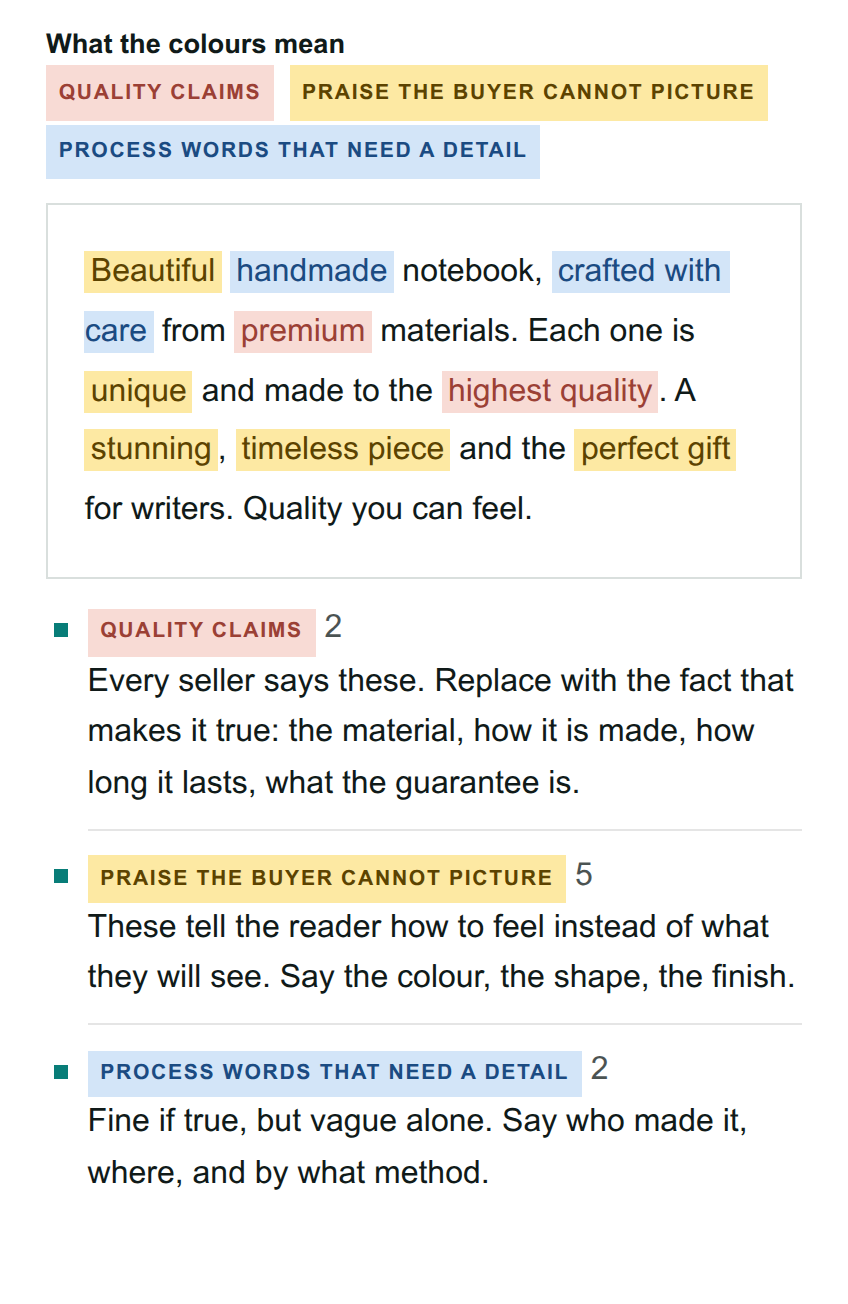
Red is for quality claims (“premium”, “finest”, “built to last”), yellow for praise the buyer cannot picture (“beautiful”, “unique”, “the perfect gift”) and blue for process words that need a detail beside them (“handmade”, “artisan”, “sustainable”). On the example it marks nine things. It misses “Quality you can feel”, because “quality” by itself isn’t on the list.
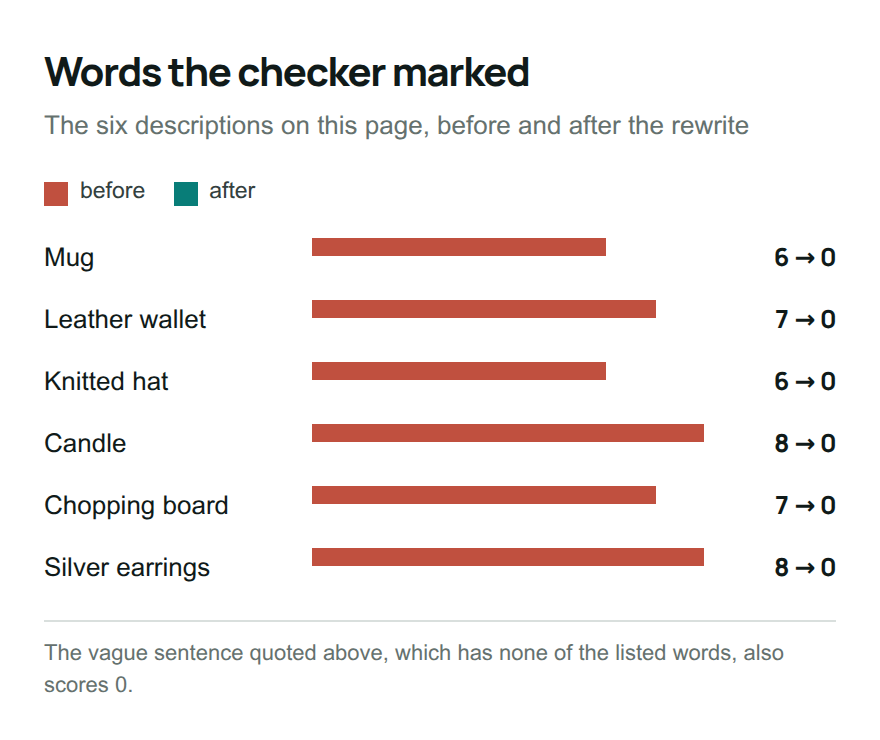
We ran all twelve descriptions on this page through it. The six weak ones got between six and eight highlights each and the six rewrites got none. Then we ran this:
This mug is very well made and looks really good. You will love using it every day. It makes a good present.
It also got none, and it tells the buyer nothing.
The checker matches a list and understands nothing about your product, so an empty result only means the listed words are absent. It errs the other way too: “Handmade by me in Leeds” is flagged although the detail is there, and so are “great” in “Great Britain” and “natural” in “natural light”. The rest of this page is about what should stand where those words were.
The question each word is avoiding
A better adjective won’t help. “Superior” and “exceptional” have the same problem as “high quality”: the buyer can’t check them. Answer the question behind the word instead. Each line below gives the word, what the buyer is asking when they read it, and what an answer looks like.
- High quality, premium, finest. What is it made of? How is it joined or finished? How long will it last, and what happens if it doesn’t? An answer: “1.4 mm vegetable-tanned cowhide, stitched by hand with waxed linen thread. Free restitching if a seam fails.”
- Unique, one of a kind. What differs from one piece to the next? Will mine look like the photo? An answer: “The hammer marks differ on every disc, so your pair will not match the photo exactly.”
- Handmade, handcrafted, artisan. Which steps are done by hand? By whom, and where? Is anything bought in? An answer: “I saw, hammer, solder and polish each pair at my bench in Cardiff. The ear wires are bought in.”
- Luxurious, luxury. What does it weigh? What does it feel like to hold or wear? An answer: “Weighs about 2.1 kg. The bare clay feels slightly rough.”
- Beautiful, stunning, elegant. What colour, shape and surface will I see? An answer: “Speckled off-white glaze. A dark yellow-green.”
- The perfect gift. Will it fit the person? Does it arrive boxed? How long until it ships? An answer: “Fits heads 54 to 58 cm. Knitted to order in about five days.”
- Natural, eco-friendly, sustainable. Which material, in which part of the product? An answer: “Soy wax, a cotton wick, a glass jar with a metal lid.”
- Timeless, built to last. How do I look after it? How will it change with use? An answer: “Oil it every month or so. The leather darkens with handling.”
- Made with love, crafted with care. What do you do that takes longer than it has to? An answer: “Sanded to 240 grit. Edges burnished with beeswax.”
If you can’t answer the question, delete the word.
Five more descriptions, before and after
The rewrites below run to three or four times the length of the originals, and you may think that is too long for a listing. I don’t. Nobody reads a product description for pleasure. They read it to find one fact, the size or the material or whether it can go in the dishwasher, and the long version is the one that has it. If your shop limits the length, I’d keep the size, the material and what varies from the photo, and cut the rest.
Leather wallet
Before
Luxury handcrafted leather wallet. Made from the finest high-quality leather with exceptional attention to detail. A timeless accessory that only gets better with age.
After
Bifold wallet in 1.4 mm vegetable-tanned cowhide, chestnut brown. Four card slots, two hidden pockets and one note section; it holds eight cards. 11 x 9 cm closed, 1 cm thick when empty. I cut each piece by hand and saddle-stitch it with waxed linen thread, two needles through every hole. Edges are sanded and burnished with beeswax. The leather starts pale and darkens with handling and sunlight; expect it to look noticeably different after a few months. Scars and growth marks from the hide are left in.
“Gets better with age” was the one phrase in the original with a fact behind it. The rewrite says what the change is, so a buyer who wants the wallet to stay the colour in the photo knows not to order it.
Knitted hat
Before
Lovely hand-knitted beanie made with love from natural, sustainable wool. Super soft, cosy and stylish. One of a kind!
After
Ribbed beanie knitted by hand in 100% merino wool, aran weight, in the colour Moss (a dark yellow-green). Fits heads 54 to 58 cm; the rib stretches. 22 cm deep, worn with a 6 cm turn-up. The yarn is dyed in small lots, so the green may be a shade lighter or darker than the photo. Hand wash in cool water with wool detergent, press in a towel, dry flat. Do not tumble dry. I knit each hat to order, which takes about five days.
A colour name like Moss means something only to the person who chose it, so it gets a plain description in brackets.
Candle
Before
Our luxurious artisan candle is hand-poured using the best natural ingredients. An amazing, long-lasting scent that makes any room feel special. Eco-friendly and a must-have for your home.
After
Soy wax candle in a 200 ml amber glass jar with a metal lid. 170 g of wax, one cotton wick. Scent: bergamot peel first, then cedarwood and a little black pepper. It is noticeable in a bedroom or study and faint in a large open room. Burn time is around 35 hours if you keep the wick trimmed to 5 mm. Poured by two of us in Bristol in batches of 24. The top can set slightly uneven; that does not affect how it burns. On first use, let the whole surface melt before you put it out, which takes about two hours.
The buyer can’t smell a screen, so name what is in the scent and say how strong it is in a room of a given size. “Long-lasting” turns into a number of hours and the condition attached to it.
Wooden chopping board
Before
Stunning handmade wooden chopping board. Superior craftsmanship and top quality natural wood make this a unique, durable addition to any kitchen. Built to last.
After
Chopping board cut from a single piece of European beech, 40 x 25 cm and 3 cm thick. Weighs about 2.1 kg, heavy enough to stay put on the worktop. One long edge has a finger groove for lifting. Sanded to 240 grit and finished with food-safe mineral oil and beeswax. Wash by hand and dry it standing on its edge. Do not put it in the dishwasher or leave it soaking; it will warp or split. Oil it every month or so, when the surface starts to look dry. Grain and colour differ from board to board, and some have small knots.
“Natural wood” names no tree. “Built to last” is true only if the owner looks after the board, so the care instructions are the honest form of that claim.
Silver earrings
Before
Elegant handmade silver earrings. These exquisite, one-of-a-kind earrings are crafted from premium quality sterling silver. A gorgeous, unique gift for someone special.
After
Drop earrings in sterling silver (925). Each disc is 12 mm across, cut from 0.8 mm sheet and hammered on one face, which leaves a dimpled surface. Total drop from the top of the ear wire is 28 mm. About 1.2 g each. I saw, hammer, solder and polish each pair myself at my bench in Cardiff; the ear wires are bought in, also sterling silver. The hammer marks differ on every disc, so your pair will not match the photo exactly. Silver tarnishes in air; a polishing cloth brings it back.
Sterling silver is already a defined standard (the FTC’s Jewelry Guides reserve the word for metal that is at least 925 parts per thousand pure silver), so “premium quality sterling silver” adds nothing to “sterling silver”.
You can keep the word handmade
“Handmade” carries real information and you don’t have to drop it. It needs the detail next to it: “Handmade in Leeds: thrown, trimmed and glazed by one potter” tells the buyer which steps and by whom. Say what is bought in as well, as the earrings above do with the ear wires.
In some places the word has a legal meaning for particular goods. The US Federal Trade Commission’s Jewelry Guides say it is unfair or deceptive to call a jewellery product handmade unless “the entire shaping and forming of such product from raw materials and its finishing and decoration were accomplished by hand labor and manually-controlled methods”. If you assemble bought components, describe what you do (“assembled and finished by hand”) instead of using the bare word.
The environmental words are covered more widely. The UK Competition and Markets Authority’s guidance on environmental claims says that terms like “green”, “sustainable” or “eco-friendly”, “especially if used without explanation”, are likely to be read as saying the whole product has a positive environmental impact or at least no adverse one, and that a business which can’t prove that “risks falling short of its legal obligations”. The FTC’s Green Guides say much the same for the US: marketers should not make unqualified general environmental benefit claims. The fix is the same as everywhere else on this page: name the specific thing that is true (the jar is glass, the wax is soy, the box is recycled card) and leave the general word out. This is a summary of published guidance, not legal advice for your shop.