How to Describe Your Language Level on a CV


Write a level from a published scale, say whether a test or you yourself assigned it, and split it by skill if your speaking and writing are not at the same level. An adjective on its own (“English: fluent”) tells the reader less than it seems to, because nobody has fixed what the adjectives mean. Two CV-advice pages we read show the problem: Cake describes “proficient” as the level above “fluent”, and Resume Genius describes “fluent” as the level above “proficient”.
The two forms this page works towards:
- With a certificate:
English: C1 (IELTS Academic 7.5, March 2026) - Without one:
English: B2 (CEFR, self-assessed)
Find your level in the official wording
The Common European Framework of Reference (CEFR) has six levels, A1 to C2, and a self-assessment grid that describes each level in five skills: listening, reading, spoken interaction, spoken production and writing. Europass, the EU’s CV service, publishes the full grid on one page. Every cell is a statement beginning “I can”. Read along a row until you reach a statement you can’t honestly make; your level in that skill is the one before it.
Three levels from two of the rows, quoted from the grid, to show how it reads:
- B1. Spoken interaction: “I can enter unprepared into conversation on topics that are familiar, of personal interest or pertinent to everyday life”. Writing: “I can write simple connected text on topics which are familiar or of personal interest.”
- B2. Spoken interaction: “I can interact with a degree of fluency and spontaneity that makes regular interaction with native speakers quite possible.” Writing: “I can write clear, detailed text on a wide range of subjects related to my interests.”
- C1. Spoken interaction: “I can express myself fluently and spontaneously without much obvious searching for expressions.” Writing: “I can write about complex subjects in a letter, an essay or a report, underlining what I consider to be the salient issues.”
Do all five rows, not one. Someone who has worked for years in a second language but never studied it formally may recognise themselves in the C1 speaking cell and the B2 writing cell. Someone who learned a language from textbooks and papers may be B2 in reading and A2 in spoken interaction (“I can handle very short social exchanges, even though I can’t usually understand enough to keep the conversation going myself”). The grid is built to show that, and a CV line can show it too:
- Levels differ:
English: speaking and listening C1, writing B2 (CEFR, self-assessed) - Levels match:
English: B2 (CEFR, self-assessed)
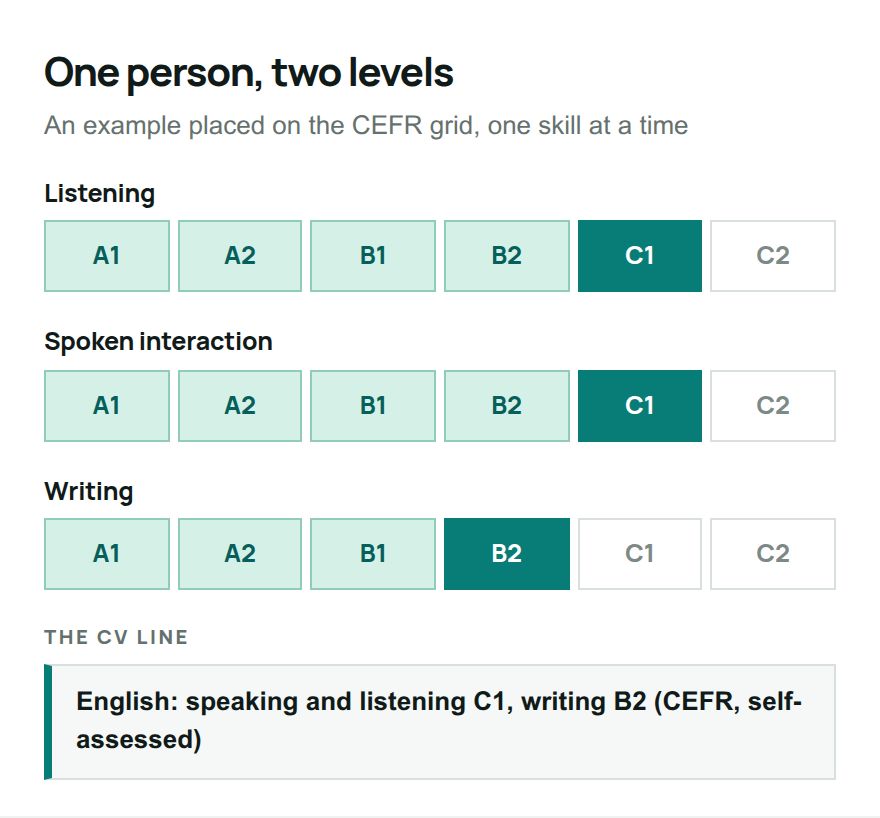
If the job is mostly one skill, such as phone support or written reports, put that skill first.
What the adjectives mean where a scale uses them
None of the common CV adjectives is defined for CVs by anyone. Some of them do appear in published scales, and that is the only firm meaning they have.
- Fluent. The CEFR grid first mentions fluency at B2, qualified (“a degree of fluency”), and without qualification at C1 (“fluently and spontaneously”). The US government’s ILR scale uses the word at Speaking Level 4: “Able to use the language fluently and accurately on all levels normally pertinent to professional needs.”
- Proficient. CEFR groups its levels into basic user (A1, A2), independent user (B1, B2) and proficient user (C1, C2); the bands are printed on Cambridge’s CEFR diagram. Cambridge’s C2 exam is called C2 Proficiency.
- Basic. CEFR’s “basic user” is A1 and A2.
- Conversational. Not a level on any scale we checked. The grid mentions conversation at B1, in the line quoted above. ILR Speaking Level 1 is “very simple face-to-face conversations on familiar topics”.
- Working knowledge. Not a level either. The nearest named level is ILR Level 2, “Limited Working Proficiency”: “Able to satisfy routine social demands and limited work requirements.”
- Native. The CEFR grid has no native level; it stops at C2. ILR Level 5, “Functionally Native Proficiency”, is speech “functionally equivalent to that of a highly articulate well-educated native speaker”.
So “fluent” could honestly be claimed from B2 upwards on one scale and only at Level 4 of 5 on another. That is the reason to add the level.
LinkedIn’s five labels
LinkedIn offers five choices: Elementary proficiency, Limited working proficiency, Professional working proficiency, Full professional proficiency, and Native or bilingual proficiency. The names are listed in LinkedIn’s developer documentation. LinkedIn’s help pages define none of them; we searched.
Some CV guides, Cake’s and SEEK’s among them, give names like these as the ILR levels. They are close, but ILR’s own base-level names for speaking are Elementary, Limited Working, General Professional, Advanced Professional and Functionally Native Proficiency. For people “who have not taken a U.S. Government-sponsored speaking test”, ILR publishes a yes/no self-assessment of speaking. It calls the result an estimate, so mark it as self-assessed.
There is no conversion table between the scales
We looked for an official conversion between CEFR and the American scales and did not find a general one. The body behind the ACTFL scale says why: “frameworks cannot be aligned based solely on their constructs”, only “on a test by test basis”. What ACTFL does publish is a one-directional mapping for its own tests, and it differs by skill: Superior on its speaking test corresponds to C2, while Superior on its reading or listening test corresponds to C1.2. CV sites often print a chart lining up A1 to C2 against ILR 0 to 5. We found no such chart from the owners of either scale, so we haven’t printed one. Use the scale the job advert uses. If it names none, CEFR has the advantage of a grid that covers all five skills on one page.
If you have a test score
Cite the level the test maker itself assigns to your score. These are the published mappings for three English tests, checked on the test makers’ pages: the IELTS overall band, the TOEFL iBT score on its 1 to 6 scale, and the Cambridge English Scale.
| CEFR | IELTS | TOEFL | Camb. |
|---|---|---|---|
| C2 | 8.5, 9 | 6 | 200 to 230 |
| C1 | 7 to 8 | 5, 5.5 | 180 to 199 |
| B2 | 5.5 to 6.5 | 4, 4.5 | 160 to 179 |
| B1 | 4 to 5 | 3, 3.5 | 140 to 159 |
IELTS. The mapping is a chart on IELTS and the CEFR, and it applies to the overall band, not the four section bands. IELTS calls band 8 “borderline” with C2, says band 5 sits on the line between B1 and B2, and says of 6.5 that “many 6.5 test takers would be at C1” but “a number will be marginally below”. It also warns that the chart should not be read as “strong claims about exact equivalence”. If your band is on a border, write the lower level.
TOEFL iBT. Since 21 January 2026 the test has been scored from 1 to 6, and ETS’s table maps each score to a CEFR level, for the total and for each section. Score reports show the CEFR level. For an older score out of 120, the same page has ETS’s comparison of the two scales (95 to 106 corresponds to 5, for instance).
Cambridge. The results page gives the level for every exam and grade. The level can differ from the exam’s name: grade A in B2 First (180 to 190) is reported as C1, and a C1 Advanced score of 160 to 179 is reported as B2. Your certificate states the level, so copy it from there.
A certificate from years ago
The test makers differ on this. IELTS recommends that results “are considered valid for two years”, ETS says TOEFL scores “stay active for two years”, and Cambridge says its certificate “does not expire” while leaving it to each organisation to decide how long to accept it. Whatever the test, give the year and let the reader judge. If you have used the language since, say so in the same line. If you have not, the grid above will tell you whether the old level still describes you.
Lines for common cases
- First language:
Albanian: native - Recent certificate:
English: C1 (IELTS Academic 7.5, March 2026) - Certificate from years ago, language still in use:
English: C1 (Cambridge C1 Advanced, 2017); working language since 2019 - No certificate, same level throughout:
Italian: B2 (CEFR, self-assessed) - Strong in speech, weaker in writing:
English: speaking and listening C1, writing B2 (CEFR, self-assessed) - You read it but hardly speak it:
German: reading B2, speaking A2 (CEFR, self-assessed) - The advert asks for “fluent Spanish”:
Spanish: fluent (speaking C1, writing B2; CEFR, self-assessed)
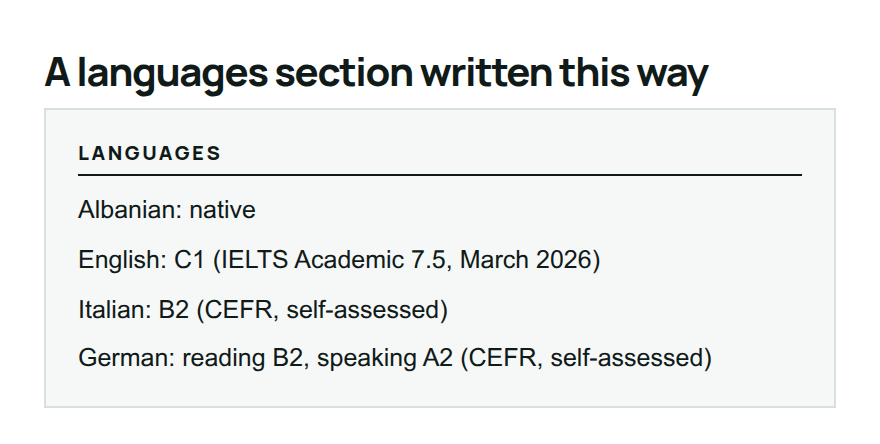
The first line in that list is my own. Albanian is my first language, and English, German and Spanish are the ones I studied. “Native” is the one adjective I would leave without a level beside it, for a simple reason: no scale goes that high. The CEFR grid stops at C2, so there is nothing to put in the brackets.
In the last line the advert’s word is kept so the match is visible, and the levels say what you mean by it. “Self-assessed” is not a weakness to hide. It tells the reader where the level came from, and the UK graduate careers site Prospects gives the practical reason for staying accurate in its CV guide: “Don’t exaggerate your abilities, as you’ll need to back up your claims at interview.”
For the rest of the CV, see what to write instead of “responsible for”.
Corrected on 7 October 2026: this page said an older TOEFL iBT score of 95 and above corresponds to 5 on the new scale. ETS’s comparison gives 95 to 106 for 5; higher scores correspond to 5.5 and 6.