Should You Delete “Just” From Your Emails?


Not as a rule. Here are two sentences with “just” in them.
Could you just add your name to the training list before you leave today?
Hi Marta, I just wanted to check in on the supplier invoices and see where things are.
The first is fine. The request is there in plain view, and “just” tells the reader it is a small one. The second has a problem, and “just” is not it. Take the word out and you get “I wanted to check in on the supplier invoices”, which still doesn’t say what Marta is supposed to do. The trouble is the whole opening phrase, which stands where the request should be.
That is the difference the usual advice misses. Articles that tell you to delete “just”, “sorry” and “I think” treat every softener as the same fault. Some of them are doing work: being polite about an imposition, marking a guess as a guess, apologising for a mistake. Others are filler in front of a request that never quite arrives. You can tell which is which with three questions.
Three questions to ask before you cut anything
Is there a request, and can the reader find it in the first line? If you want something, the first line should say what and by when. A softener that sits inside a clear request (“Could you just…”, “Would you mind…”) is politeness and can stay. A softener that replaces the request (“I just wanted to check in”, “I was wondering if you’d had a chance”) leaves the reader to work out what you want. Rewrite those. Deleting one word won’t do it.
Are you actually unsure? “I think”, “probably” and “maybe” tell the reader how far to rely on what follows. If you haven’t checked, the hedge is information and removing it makes the sentence less true. If you have checked, or you have made up your mind, it is noise.
Did you do something wrong, or are you asking for more than the reader owes you? Then “sorry” is the right word. If you are asking a colleague for something that is part of their job, during working hours, there is nothing to apologise for.
Mark the softeners in your own draft
The box below marks softeners in whatever you paste into it, so you can see where to ask the three questions. It works inside your browser, and what you paste stays on your device. The example button loads an email written to contain as many as possible.
Highlight the softeners in an email
Runs in your browser. Your text is not sent anywhere or stored.
Red is for 21 set phrases that tend to stand where the request should be, such as “I just wanted to”, “I was wondering if” and “no worries if not”. Yellow is for 17 softeners, such as “just”, “maybe” and “I think”. Blue is for four apology words. On the example it makes 12 marks: 7 red, 4 yellow and 1 blue. “Might” is not marked, because it isn’t on any list.
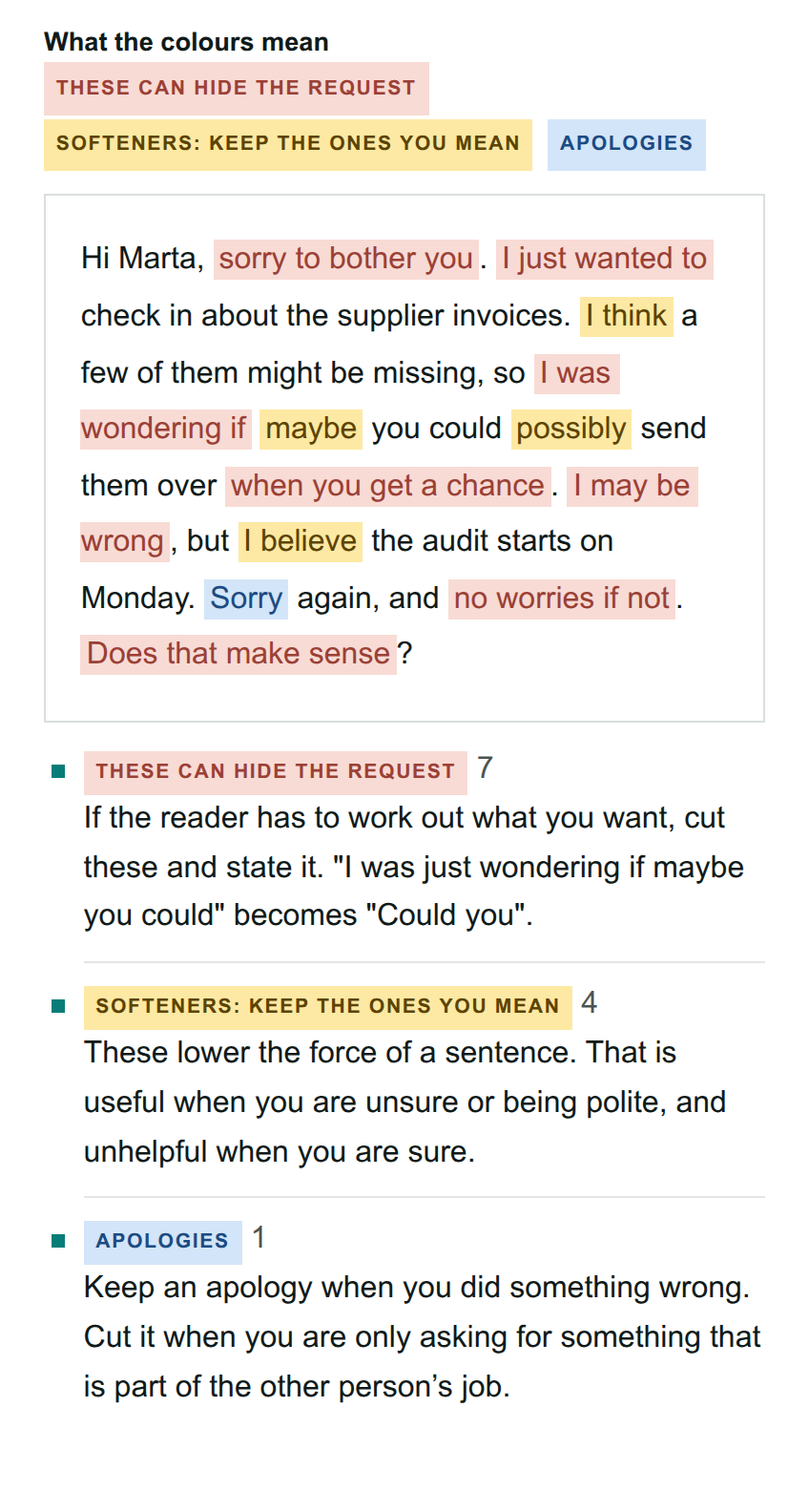
The checker matches words and nothing more. We ran “I just sent it” and “The server went down just before nine” through it, and it marked “just” in both, although neither is a softener. It also marks the “sorry” in the budget apology and in the reception request further down this page, and both of those should stay. A mark tells you where to ask the questions. It is not a verdict.
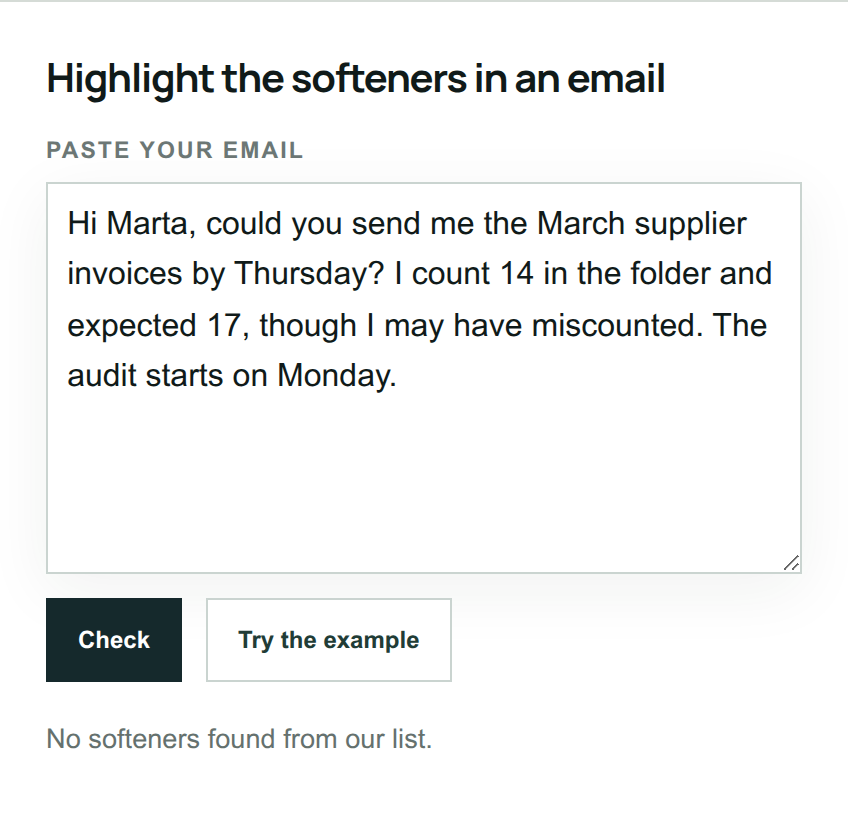
Here is the example email after asking them. There is a request, so it goes first. The writer is unsure about the count, so that hedge stays, with the reason. Nobody did anything wrong, so both apologies go.
Hi Marta, could you send me the March supplier invoices by Thursday? I count 14 in the folder and expected 17, though I may have miscounted. The audit starts on Monday.
The checker finds nothing to mark in that version, and it still contains a hedge.
Ten sentences, with and without
We made these ten up, and none is from anyone’s inbox. Each is shown with the hedge and without it, followed by whether the hedge was doing a job.
Requests
With: Hi Marta, I just wanted to check in on the supplier invoices and see where things are.
Without: Hi Marta, are the March supplier invoices ready? I need them by Thursday for the audit.
No job. Nobody reading the first version knows whether a reply is wanted. The fix was to write the question and the deadline.
With: I was just wondering if you might have had a chance to look at the contract?
Without: Have you read the contract? I need your comments by Wednesday to send it back on time.
No job. The first version asks about a chance, so “not yet” is a complete answer and you are no further on. The second says what you need and when.
With: Could you just add your name to the training list before you leave today?
Without: Add your name to the training list before you leave today.
Doing a job. The request is already clear, with a deadline. “Just” says it will take a moment and “could you” makes it a request, not an order. Without them it reads as an instruction, which is fine from a manager posting a notice and abrupt from a colleague.
With: The onboarding notes are in the shared folder, if that makes sense.
Without: The onboarding notes are in the shared folder, under Onboarding 2026.
No job. There is nothing in the sentence that could fail to make sense, so the tag only makes the reader wonder what they missed. If you are worried the notes will be hard to find, say where they are.
Opinions and facts
With: I think the March figure includes VAT, but I haven’t checked the ledger.
Without: The March figure includes VAT.
Doing a job. The writer hasn’t checked. The second version turns a guess into a statement that someone may put in a report. Keep the hedge, and keep the reason for it, so the reader knows what would settle the question.
With: I think we should probably maybe look at moving the launch to March.
Without: I think we should move the launch to March. The supplier can’t deliver before 20 February.
One of the four was doing a job. “I think” marks this as a proposal the reader can argue with, which is honest if the decision isn’t yours alone. “Probably”, “maybe” and “look at” say the same thing three more times. What the sentence lacked was the reason, and the reason does more for it than any change of tone.
With: Actually, the meeting is on Tuesday, not Monday.
Without: The meeting is on Tuesday, not Monday.
Doing a small job. “Actually” appears on most lists of words to delete, but here it signals that you are correcting something the reader said. Both versions are fine. The second is a little blunter, and that is the only difference.
Apologies
With: Sorry, I sent you the wrong version of the budget yesterday. The right one is attached.
Without: I sent you the wrong version of the budget yesterday. The right one is attached.
Doing a job. The writer made a mistake that may have cost the reader time. One “sorry”, followed by the fix, is what the reader is owed.
With: Sorry to bother you, but could you approve my leave request?
Without: Could you approve my leave request for 2 to 6 November? HR needs it by Friday.
No job. Approving leave is part of a manager’s work, so there is nothing to be sorry for. The space is better used for the dates and the deadline.
With: I’m sorry to ask at short notice, but could you cover reception from 2pm to 3pm today?
Without: Could you cover reception from 2pm to 3pm today?
Doing a job. This is a favour, it isn’t the reader’s work, and it is being asked for on the day. The apology admits all that, and the request is still in the first line with the times in it. Compare it with the leave request above: the same word, with a different answer to the third question.
Count them up and five of the ten hedges were worth keeping, four were not, and one sentence was carrying three spares. A rule that says “delete them all” would have left four of these emails ruder or less accurate than they were, and a fifth a little blunter. Ten sentences that we wrote ourselves prove nothing about email in general. They are here to show that the same word can be right in one line and wrong in the next.
If you want my own rule in one line, it is this: cut the hedge when it is standing in for the request, and keep it when it is true.
Where the advice came from
In 2015 Ellen Petry Leanse, who had worked at Google and Apple, published “Just” Say No on LinkedIn. She called “just” a “permission” word and had the impression women used it far more than men. In her words, “I had no data”. Her one test was an audience counting the word while a woman and a man each spoke for three minutes, and her own verdict on it was “that’s not research”.
That December a Chrome extension, Just Not Sorry, turned the idea into software (first public release 16 December 2015). It underlines listed phrases in Gmail and now Outlook on the web. Its phrase list backs almost every warning with a quotation from a coach or a writer; the entry for “try” quotes Yoda. None of the links behind them goes to a journal. Coverage such as The Muse’s article on the extension passed the list along.
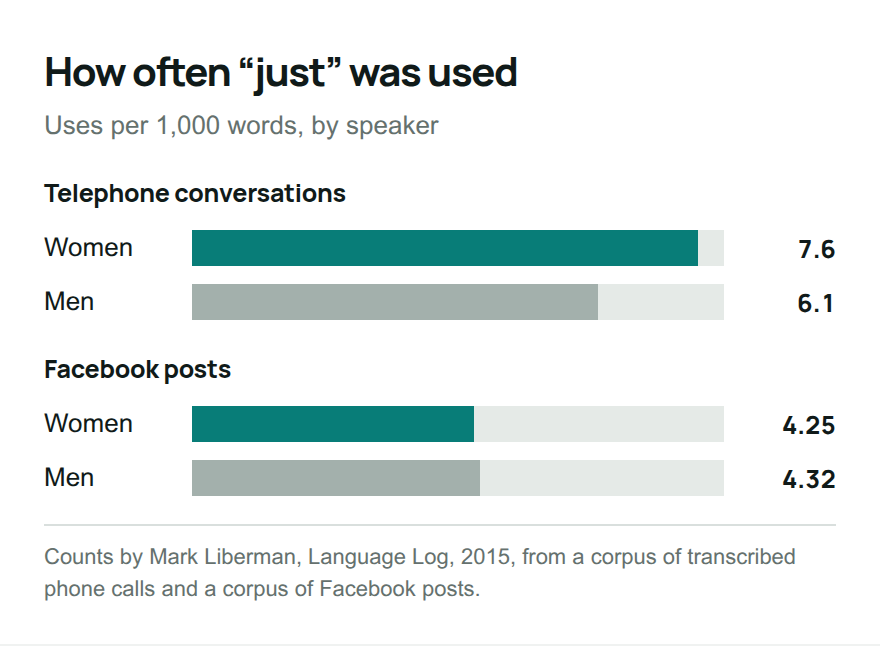
Two linguists answered at the time. Mark Liberman checked the hunch against real language: in transcribed phone conversations women used “just” 7.6 times per thousand words and men 6.1, and in a large sample of Facebook posts the rates were 4.25 and 4.32. He called that “far from a strong confirmation”. Deborah Cameron pointed out that “just” mostly softens requests, and that softening a request is ordinary politeness. Leaving it out, she wrote, can make you sound rude. She also objected that this advice is aimed almost entirely at women.
We looked for an experiment that tested the same work email with and without “just” or “sorry”, rated by the people receiving it. We did not find one. What exists is lab research on hedging in persuasive essays and speech, and we read the abstracts only, not the full papers. A 2011 meta-analysis by Leaper and Robnett in Psychology of Women Quarterly found women slightly more likely than men to use tentative language. One experiment (Blankenship and Holtgraves, Journal of Language and Social Psychology, 2005) found hedges made an argument less convincing to readers who cared about the subject, another in the same journal (Durik and colleagues, 2008) concluded that hedges “can, but do not always, undermine persuasive attempts”, and a 2022 preprint by Oba and Berger found some kinds of hedge more persuasive than others. None was about email. Stacking hedges on an argument can cost you, as in the launch sentence above. The claim that these words should all go rests on a hunch its own author said was not research.
Corrected on 8 October 2026: the count after the ten sentences said that deleting every hedge would have made five of the emails ruder or less accurate. By the article’s own verdicts it is four, and a fifth a little blunter.